What to Expect
an underwater session, start to finish.
Almost everyone who books a session with me has never done anything like it. They have questions they are slightly embarrassed to ask, and a picture in their head that is usually more frightening than the real thing.
So here is the whole process, in order, with nothing left out. If you read this and still have a question, ask me. I would much rather answer it now than have you wondering about it on the edge of the pool.
Before we shoot
We talk first. Every session starts with a pre-production meeting — a phone call or a Zoom, usually a week or two ahead. This is not a formality. It is where the session actually gets designed.
We talk about what you want out of it. Some people arrive with a fully formed idea; most arrive with a feeling, a color, a piece of music, a photograph they saw once. Both are workable. We talk about wardrobe, about props, about what works underwater and what does not — and a surprising amount does not. Heavy fabric sinks. Stiff fabric stays stiff. White goes translucent. Things you would never guess turn out to be the difference between a good frame and a great one.
By the end of that call you will know what to bring, what to wear, and roughly what we are going to make together.
Wardrobe that works. Long, light, loose. Chiffon, silk, tulle, jersey — anything that moves. Solid colours photograph better than busy patterns. Bring more than you think you need; a one-hour session covers two outfits and a two-hour session covers four, and having options in the bag is better than wishing you had them. We have dozens of large pieces of colored fabric that you are welcome to use for your session if you like.
The day itself
Getting there. Sessions run in a private heated saltwater pool in the Orlando area. I will send you the address and parking details once we book. Give yourself a few extra minutes; arriving rushed is the one thing that genuinely makes the first twenty minutes harder.
Getting in. We do not start shooting immediately. You get in the water and spend a while just being in it — floating, ducking under, getting used to how different your body feels when it weighs nothing. The camera stays on the deck. This part is not wasted time; it is the part that makes everything after it work.
You won’t get cold. The water is heated year-round and sits around ninety degrees, which is warmer than most people expect. You will not be cold, and you will not be counting the minutes until you can get out. That matters more than it sounds — cold is what ends most underwater sessions early.
Who is in the water with you. You are never alone. A safety swimmer is in the pool for the entire session, and she becomes a posing coach who works with you between takes — someone whose whole job is to watch what your hands and shoulders are doing and tell you what to change. I am shooting; she is looking after you, making sure you are safe and posing well.
You are welcome to bring a friend, a partner, or whoever makes you feel steady. A lot of people do, and it helps.
How the shooting actually goes
Here is the rhythm: you go down, we make a few frames, you come up. You rest. We look at each other, I tell you what I saw, you tell me how it felt, and we go again.
You don’t have to be an expert free-diver: Nobody is holding their breath for a long time. Most of the good images come from ten or fifteen seconds underwater. The work is not endurance — it is doing something specific and controlled in a short window, then surfacing and doing it again. Sessions are built around rest, not around pushing.
One safety point worth mentioning: do not hyperventilate or take a series of rapid deep breaths before going under. It feels like it helps and it does the opposite — it makes it possible to lose consciousness without ever feeling the urge to breathe. One normal, relaxed breath is all you need for what we are doing. I will say this again on the day.
Your eyes. Open eyes often make the photograph. Saltwater is considerably kinder than chlorine here, and most people can manage it within a few minutes of trying. If you wear contacts, bring your glasses and a spare set of lenses. If opening your eyes turns out to be genuinely miserable for you, we will work around it — there are beautiful images to be made with eyes closed.
Hair and makeup. Hair is a subject in its own right underwater; it does things you cannot direct and should not try to. Waterproof and long-wear products hold up far better than regular makeup, and less is generally more — water does a lot of the softening for you.
Expect to work. Underwater modeling is physical. You will be tired afterwards, in a good way, and you will probably be hungry. Eat something beforehand, but not a heavy meal, and drink water during the day. It is hard work, and it is worth every bit of it.
Afterwards
Within two weeks, you will get a private online gallery of watermarked, un-retouched previews. These are for choosing from, not for judging — an un-retouched underwater frame always looks rougher than the finished image.
You choose your favorites. Your session includes one fully retouched image and a canvas print; additional retouching is available if you want more. From there, prints and larger pieces are up to you.
Your images are yours. Nothing goes on this site, on Instagram, or anywhere else without your say-so.
Ready to book a session?
Still deciding?
The people who get the most out of a session are not the confident swimmers or the experienced models. They are the ones willing to try something and see what happens. If that sounds like you, let's talk.
Send us a note on the Contact Form, or call or text me directly at 321-947-9431
Read the FAQ for the shorter answers, or the Rates if you want the numbers first.
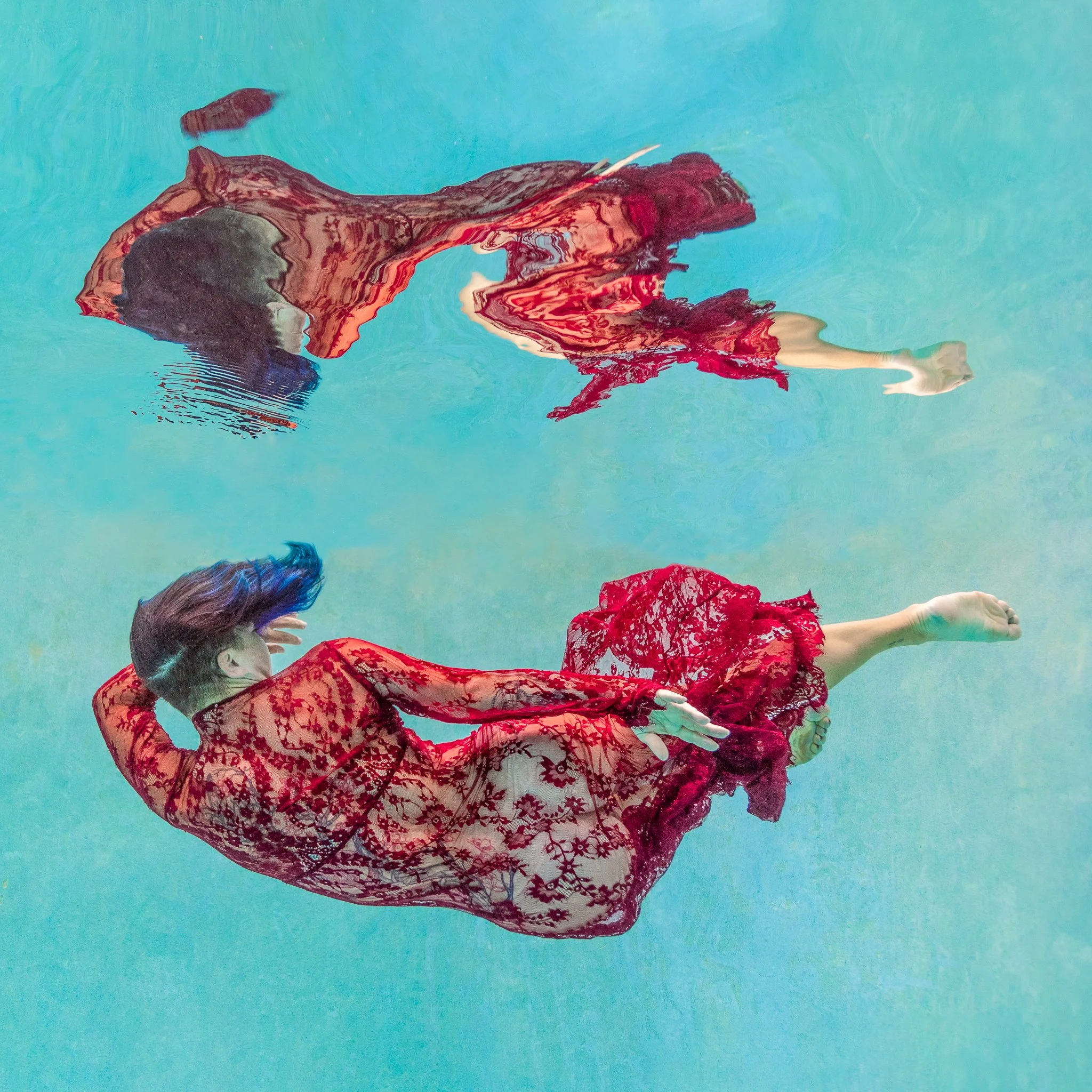
It takes time and practice to get comfortable and relaxed underwater, and we’ll work with you to get the best out of every session. Michelina is a great posing coach and safety swimmer.